
How to Choose the Right Floor Saw
Choosing the correct floor saw requires careful evaluation of several factors:
1. Material to Be Cut
The material to be cut is the most important selection criterion. Concrete and asphalt place fundamentally different demands on the machine and the saw blade. When cutting old or fresh concrete, the hardness of the aggregate and the degree of reinforcement determine which blade specification offers the best combination of cutting performance and service life. Asphalt, on the other hand, requires a different segment technology designed for high feed rates and low cutting pressure.
2. Cutting Depth Required
The required cutting depth depends directly on the specific application. For installation work in buildings — such as cutting cable ducts or expansion joints in floor slabs — compact models with cutting depths of 150–250 mm are usually sufficient. For road construction and deep cutting, larger machines capable of reaching 400–550 mm are necessary.
3. Project Scale and Duration
For small, one-off jobs, a rental unit at $150–$300 per day may be more cost-effective than purchasing. For contractors who cut regularly, investing in a floor saw is more economical over time.
4. Power Source and Site Conditions
Indoor projects require electric floor saws due to emission restrictions, while outdoor and remote sites favor petrol or diesel models for their mobility and power. Electric floor saws produce no emissions when in use, making them ideal for indoor applications such as cutting trenches in concrete for data cables.
5. Blade Selection
The blade size of a floor saw determines the cutting depth and can range from 12 to 36 inches (300 mm to 1,200 mm). For smaller projects, a 300–500 mm blade is sufficient, while larger blades are suitable for thicker materials or deeper cuts.
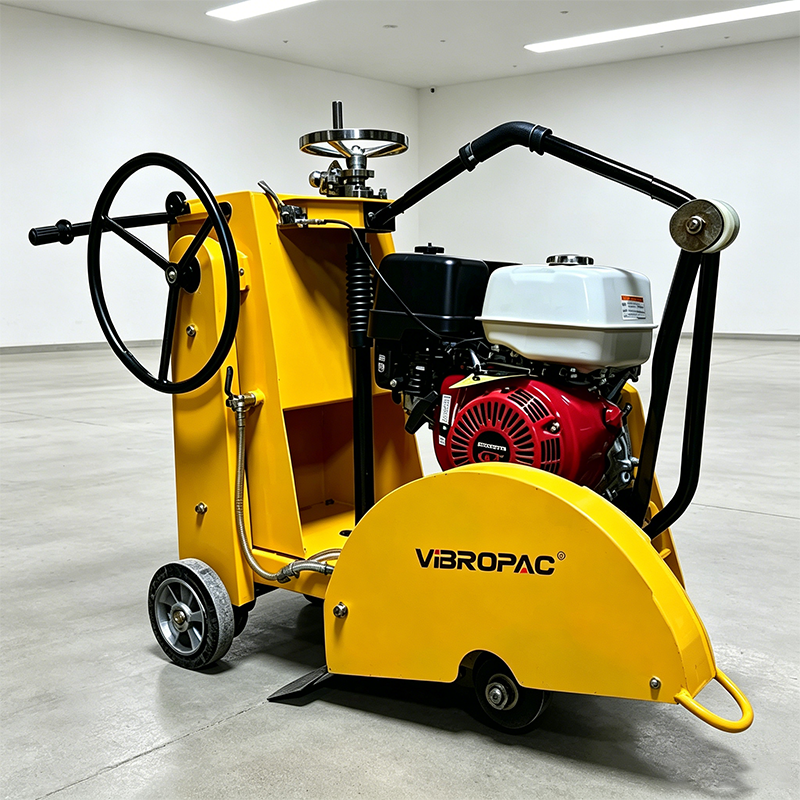
Safety and Maintenance Best Practices
Safe operation of a floor saw is critical. Key safety guidelines include:
-
One operator only — The floor saw may only be operated by one person. Banish other persons from the work area.
-
Use suitable blades only — Only use saw blades with suitable type and dimensions. NEVER use damaged saw blades.
-
Ensure stable water supply — Water is used for cooling during cutting and for dust suppression. Ensure continuous water flow before starting a cut.
-
Remove obstacles — Clear all obstacles from the cutting area and ensure good lighting.
-
Check for utilities — Make sure all water, gas, and electric lines are turned off in the area where you are cutting.
Regular maintenance extends the service life of your floor saw and ensures consistent cutting performance:
| Frequency | Maintenance Task |
|---|---|
| Daily | Check oil level; visual inspection for damage |
| Weekly | Check belt and chain tension; adjust as necessary |
| Every 50 hours | Lubricate grease nipples |
| Annually | Full service inspection |
Frequently Asked Questions
Q: What is the difference between a floor saw and a wall saw?
A: A floor saw is a walk-behind machine designed for horizontal cuts on floors and pavements. A wall saw is track-mounted and designed for vertical or overhead cutting on walls and ceilings. Floor saws offer faster deployment with no setup time, while wall saws provide precision on vertical surfaces but require 30–45 minutes of track setup.
Q: How deep can a floor saw cut?
A: Cutting depths vary by model and blade size. Small petrol floor saws cut up to 180 mm, medium models reach 230–300 mm, and large diesel-powered self-propelled machines can cut up to 520–550 mm or more, depending on blade and guard configuration.
Q: Can I use a floor saw indoors?
A: Yes, but you must use an electric floor saw to comply with emission regulations. Electric models produce zero emissions during operation and are quieter, making them suitable for indoor applications such as cutting trenches in concrete for data cables.
Q: How much does a floor saw cost?
A: Prices range from approximately $370 for basic push models to over $9,800 for professional-grade petrol machines. Rental costs typically run $150–$300 per day for larger self-propelled units.
Conclusion
A floor saw is an essential investment for any contractor or construction professional working with concrete and asphalt. By understanding the different types, power sources, and blade configurations available, you can select the machine that maximizes productivity while maintaining safety and precision on every job.
Whether you need a compact electric model for indoor trenching or a powerful self-propelled diesel machine for highway construction, the right floor saw will deliver clean, accurate cuts and years of reliable service.